
Understanding the Importance of Moisture Measurement in Manufacturing
Moisture content is an important quality parameter across several manufacturing industries. Excessive or insufficient moisture in raw materials can affect product characteristics, processing efficiency, storage stability, and final production quality. Therefore, manufacturers require reliable measurement methods to monitor moisture levels and maintain consistent operating conditions.
Traditional moisture testing often involves collecting material samples and analysing them separately. Although laboratory testing remains important for reference measurements and calibration, offline methods may create delays between sampling and receiving results. These delays can make it difficult to identify moisture variations while production is taking place.
An advanced moisture analyzer provides a more continuous approach by measuring moisture directly within the production process. Modern in-line analysis technology helps manufacturers monitor material conditions, identify deviations, and make informed adjustments to their processes.
Understanding the available measurement technologies and their applications is essential for businesses looking to improve quality control and production consistency.
Why Is Accurate Moisture Measurement Important?
Maintaining Consistent Product Quality
Moisture content can influence the physical, chemical, and processing characteristics of different materials. In plastic manufacturing, excessive moisture in hygroscopic polymers can contribute to processing defects and material degradation.
In food processing, moisture levels influence product texture, shelf stability, and preservation requirements. Similarly, pharmaceutical and chemical manufacturing processes often require carefully controlled moisture conditions to maintain product specifications.
Accurate measurement helps manufacturers understand whether materials meet the required moisture limits before proceeding to subsequent production stages.
See also: How Preventive Maintenance Helps Extend the Life of Industrial Equipment
Reducing Production Variations
Inconsistent moisture levels can create variations in processing conditions and finished product characteristics. Without reliable monitoring, operators may identify problems only after the material has passed through important production stages.
Continuous measurement provides timely information about changing moisture conditions. This allows production teams to investigate deviations and adjust relevant operating parameters before they affect larger quantities of material.
However, measurement results should always be interpreted alongside material specifications, process conditions, and validated quality control procedures.
How Does an Industrial Moisture Analyzer Work?
Understanding In-Line Moisture Measurement
An in-line moisture analyzer measures moisture content directly within a production or material handling process. Instead of depending entirely on manual sampling, the sensor continuously monitors material passing through its measurement point.
The measured information is transferred to a control unit, where operators can view moisture readings and monitor changes during production.
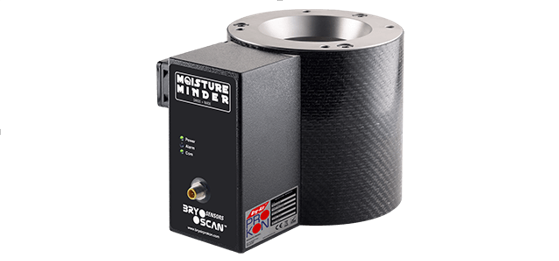
Bry-Air’s Moisture Minder™ BryScan™ Series uses specialised sensor technology to measure moisture in hygroscopic plastic pellets, flakes, and regrind. The system displays moisture readings in percentage or parts per million (PPM).
Its sensors can be installed in suitable drying hoppers, silos, material lines, and machine throats, allowing integration with different production arrangements.
The Role of BryScan™ Sensor Technology
BryScan™ is Bry-Air’s proprietary moisture measurement technology, developed for determining the core moisture content of materials.
The measurement approach uses differences in the dielectric properties of water and polymers. Water has a substantially higher dielectric permittivity than most polymer materials, allowing variations in moisture content to influence the sensor’s electrical measurement signal.
A built-in microprocessor processes these signals to calculate the moisture content of the material.
This technology is designed to measure moisture independently of material density, colour, and surface structure, supporting more consistent monitoring across different material conditions.
What Are the Benefits of Using an Advanced Moisture Analyzer?
Real-Time Monitoring and Faster Process Decisions
One of the main advantages of in-line measurement is the availability of moisture information during production.
Operators can monitor material conditions continuously rather than waiting for separate laboratory reports after sampling. This helps identify moisture variations earlier and supports timely process adjustments.
Real-time monitoring is particularly useful in manufacturing environments where moisture levels directly influence material processing and product specifications.
Improved Measurement Accuracy and Repeatability
Reliable moisture measurement requires consistent sensor performance and appropriate calibration.
Bry-Air’s Moisture Minder™ incorporates an automatic internal calibration function designed to correct accumulated errors in sensor output. This supports measurement accuracy and repeatability over time.
However, calibration against known reference moisture values remains important. The system uses reference measurements from established laboratory methods, such as Karl Fischer analysis, to develop suitable calibration relationships for the material being measured.
Following appropriate calibration procedures helps ensure that displayed readings remain relevant to the material and application.
Better Production Traceability
Manufacturing quality systems increasingly require accurate records of process conditions and material characteristics.
An advanced moisture monitoring system can collect and record moisture data, helping production teams review variations and maintain quality documentation.
This information can support process analysis, production traceability, and internal quality management procedures.
Bry-Air’s Moisture Minder™ also supports remote monitoring through compatible devices, including PCs, tablets, and smartphones, helping authorised personnel access production information.
How Does Moisture Monitoring Improve Plastic Manufacturing?
Controlling Moisture in Hygroscopic Plastics
Hygroscopic plastics absorb moisture from their surrounding environment. Materials such as PET, polycarbonate, nylon, and certain engineering polymers may require controlled drying before processing.
Excessive moisture can cause hydrolytic degradation during high-temperature processing, potentially affecting molecular weight and finished component properties.
Monitoring moisture before and after drying helps manufacturers evaluate whether the drying process is achieving the required results.
This information can also help identify changes in material conditions that may require adjustments to drying parameters or material handling practices.
Supporting Better Drying Process Management
Drying performance depends on several factors, including temperature, airflow, dew point, residence time, and initial material moisture content.
A moisture monitoring system provides additional information that helps operators assess the effectiveness of these parameters.
The Moisture Minder can be integrated with suitable production arrangements to monitor moisture levels at different points in the material handling process.
Its touchscreen control system can display data from up to eight hoppers, supporting centralised monitoring across multiple measurement locations.
The system also offers options for diverting or recirculating material that does not meet specified dryness requirements, depending on the installation configuration.
Which Industries Can Benefit from Advanced Moisture Measurement?
Plastics and Polymer Processing
Plastic manufacturers require accurate moisture monitoring to maintain suitable resin conditions before injection moulding, extrusion, and other processing operations.
In-line measurement helps evaluate drying performance and identify moisture variations before they affect product quality.
Food Processing and Grain Milling
Moisture content influences the processing characteristics, storage stability, and quality of agricultural and food materials.
Continuous monitoring can support more consistent production conditions and help maintain specified moisture requirements throughout processing.
Pharmaceutical and Chemical Manufacturing
Pharmaceutical and chemical industries often work with materials that require controlled moisture conditions.
Reliable moisture analysis helps monitor raw materials and intermediate products while supporting quality assurance and process documentation.
Construction Material Manufacturing
Certain construction materials require specific moisture conditions during production and handling.
Moisture measurement can help manufacturers monitor material consistency and maintain appropriate processing parameters.
What Factors Should Businesses Consider When Selecting Moisture Measurement Equipment?
Material Compatibility and Measurement Range
The first consideration is whether the sensor is suitable for the material being measured. Different products have different dielectric properties, moisture characteristics, and temperature requirements.
Businesses should evaluate the measurement range, sensor compatibility, material flow conditions, and required measurement accuracy.
Calibration and Technical Reliability
Calibration procedures should be appropriate for the material and measurement method. Reference testing helps establish the relationship between sensor readings and actual moisture content.
Businesses should also consider sensor stability, repeatability, automatic calibration features, and maintenance requirements.
Connectivity and Production Integration
Modern manufacturing facilities increasingly rely on connected equipment and centralised monitoring systems.
Moisture measurement equipment should support suitable communication protocols and integration requirements. Remote access, data recording, alarms, and production monitoring can provide additional operational value.
Bry-Air’s Moisture Minder™ supports industrial connectivity through interfaces such as RS-485 and Modbus RTU, helping integrate moisture information with compatible automation systems.
Conclusion
Accurate moisture measurement is essential for maintaining product quality, controlling production variations, and improving manufacturing efficiency. Traditional offline testing continues to play an important role in laboratory analysis, but in-line measurement provides additional visibility into moisture conditions while production is taking place.
Advanced moisture analysis technology helps manufacturers monitor material characteristics, evaluate drying performance, and maintain more consistent process conditions. Features such as automatic calibration, remote monitoring, data recording, and production traceability further strengthen industrial quality control.
Bry-Air’s Moisture Minder™ BryScan™ Series provides specialised in-line moisture measurement for hygroscopic plastics and other suitable industrial applications. Its sensor technology and connectivity features support more informed production monitoring and process management.
Businesses looking to improve moisture measurement and quality control can explore the available technology and discuss their specific application requirements through the official Contact Us page.