
Industrial gas turbines operate under demanding conditions, with high temperatures, pressure changes and continuous mechanical stress affecting the condition of their internal parts. Replacing worn components can involve significant costs and extended equipment downtime. For operators managing maintenance budgets, refurbished industrial gas turbine components offer an alternative to purchasing new parts, provided the components meet the required engineering and performance standards. Careful inspection, suitable repair methods and proper testing help determine whether refurbished parts can support reliable turbine operation.
Why Refurbished Components Are Considered for Turbine Maintenance
Gas turbine components experience gradual deterioration during operation. Thermal cycling, oxidation, corrosion, vibration and material fatigue can affect their structural integrity. Depending on the component and the extent of wear, restoration may provide a practical way to extend its service life.
Refurbishment generally involves inspecting a used component, identifying defects, removing damaged material where necessary and restoring its dimensions or surface properties. The work may include machining, welding, coating application and other approved repair processes.
For power generation facilities and industrial plants, this option can offer several advantages:
- Lower replacement expenditure: Suitable components can cost less to restore than purchasing new manufactured parts.
- Reduced material waste: Reusing serviceable components helps limit the amount of equipment discarded during maintenance.
- Improved parts availability: Refurbishment may provide an alternative when original components have long manufacturing or delivery lead times.
- Maintenance flexibility: Restoration can help maintenance teams plan component replacements around scheduled shutdowns.
- Extended equipment life: Properly restored parts may remain in service when they meet the applicable engineering requirements.
The financial benefits depend on the component’s original condition, repair complexity, testing requirements and expected remaining service life.
Which Gas Turbine Components Can Be Refurbished?
Not every turbine component is suitable for refurbishment. The decision depends on its material, operating history, damage level and the manufacturer’s repair specifications.
Common component categories considered for restoration include:
Combustion system components: Combustion liners, transition pieces and associated hardware are exposed to intense heat. Thermal barrier coating restoration, crack assessment and approved welding procedures may help recover their serviceability.
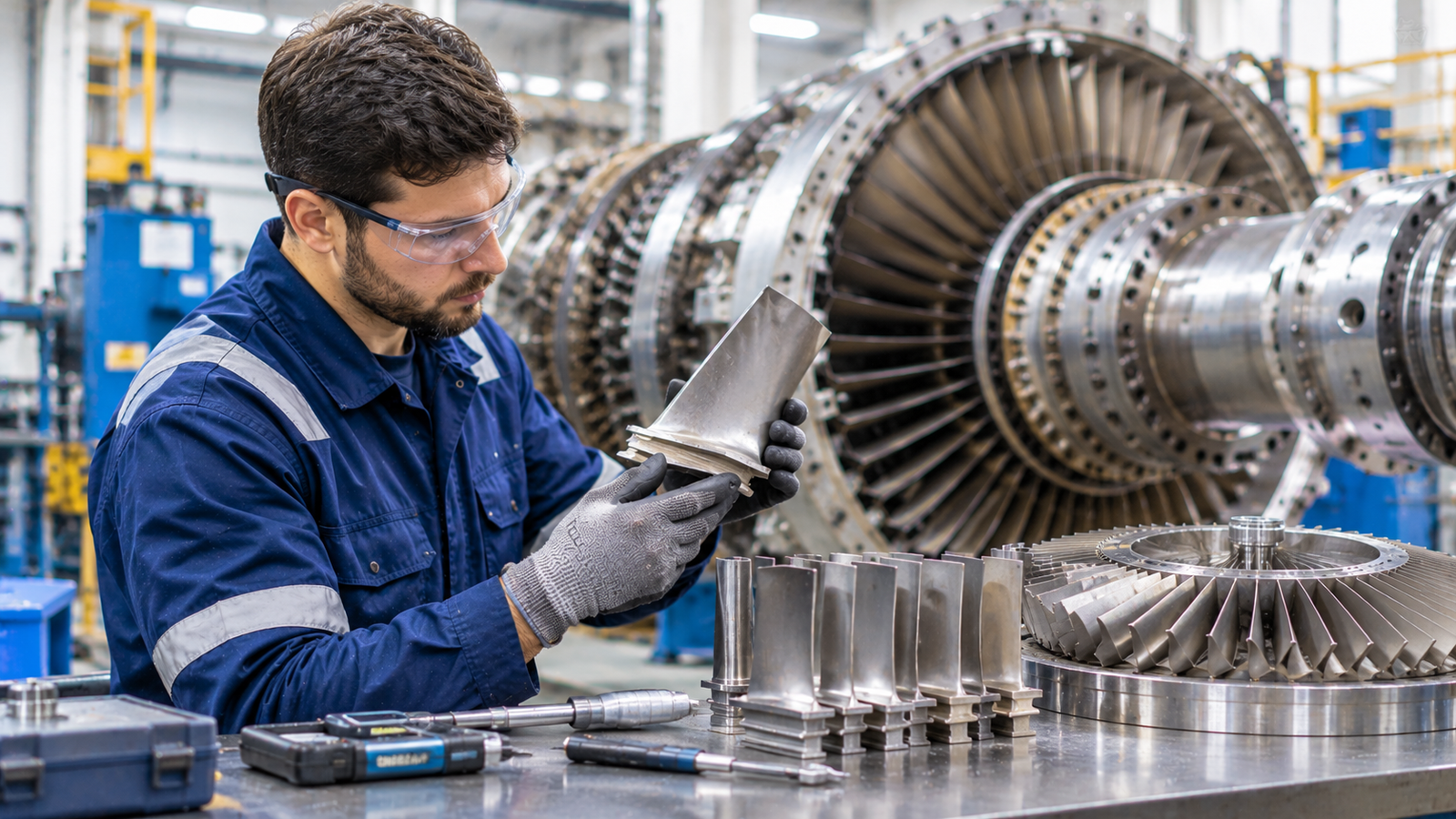
Turbine blades and vanes: These components operate under extreme temperatures and centrifugal or aerodynamic loads. Depending on their condition, restoration may involve dimensional correction, surface treatment, coating replacement and detailed crack inspections.
Nozzles and fuel system parts: Fuel nozzles and related components require accurate dimensions and controlled flow characteristics. Cleaning, machining and suitable inspection procedures help determine whether restoration is technically acceptable.
Casings and structural components: Certain housings and support structures may be repaired through approved welding, machining or surface restoration processes.
Auxiliary equipment components: Selected bearings, seals, pumps and other supporting parts may also be candidates for refurbishment, depending on their condition and design requirements.
A component should never be returned to service simply because visible damage has been repaired. Its remaining structural integrity and operating suitability must also be established.
Inspection Methods That Determine Component Quality
Inspection is one of the most important stages in the refurbishment process. It identifies defects that may not be visible during an ordinary visual examination.
A professional inspection programme may include several methods:
Visual inspection: Technicians examine surfaces for corrosion, oxidation, deformation, coating loss and other visible signs of deterioration.
Dimensional inspection: Precision measuring equipment checks whether the component remains within the specified dimensional tolerances. This is particularly important for rotating parts and components that must fit accurately within an assembly.
Non-destructive testing: Techniques such as dye penetrant testing, magnetic particle inspection and ultrasonic testing help identify surface or internal discontinuities without damaging the component.
Metallurgical examination: Material assessment can reveal changes caused by prolonged exposure to high temperatures, fatigue or other operating conditions.
Coating assessment: Engineers examine coating thickness, adhesion and surface condition to determine whether additional treatment is required.
Inspection findings should be documented and compared with the relevant repair limits. Components that exceed permissible damage thresholds should be rejected rather than restored beyond their approved service limits.
Manufacturing Expertise and the Importance of Repair Standards
Refurbishment quality depends heavily on the technical capabilities of the workshop. Turbine parts require accurate engineering, suitable materials and controlled manufacturing processes.
Companies involved in gas turbine parts manufacturing often have experience with machining, material selection, component geometry and specialised production techniques. Such knowledge can also support refurbishment work, particularly when restoring parts with complex profiles or strict dimensional requirements.
Repair procedures should account for the component’s original design, material characteristics and operating environment. Welding, brazing, machining and coating applications must follow approved technical specifications. Uncontrolled modifications can affect component strength, balance and performance.
Documentation is equally important. A reliable repair process should include inspection reports, material records, repair details and final test results. These records help maintenance teams understand what work was completed and assess whether the component is suitable for its intended application.
Choosing a Reliable Turbine Parts Supplier
Selecting a suitable supplier requires more than comparing prices. The quality of the refurbished component depends on the supplier’s technical knowledge, inspection facilities and ability to follow established repair procedures.
Consider the following points before placing an order:
- Relevant experience: Check whether the supplier has worked with the specific turbine model and component category.
- Inspection facilities: Confirm access to suitable dimensional inspection and non-destructive testing equipment.
- Repair capabilities: Review the available machining, coating, welding and material restoration processes.
- Traceability: Ask for component identification records, inspection findings and repair documentation.
- Quality assurance: Check whether the supplier follows recognised quality management procedures and applicable OEM repair requirements.
- Technical support: Assess whether engineers can assist with component selection, compatibility and maintenance planning.
A supplier should also be willing to explain the limitations of a refurbished component. Clear information about its repair history, remaining service expectations and operating restrictions helps prevent misunderstandings after installation.
The Role of Turbine Parts Manufacturing Companies in Component Restoration
Specialised manufacturers contribute to both new component production and the restoration of existing turbine parts. Their understanding of machining tolerances, material properties and engineering drawings can support accurate repair work.
A turbine parts manufacturing company may provide services such as reverse engineering, precision machining, component reproduction and restoration, depending on its technical facilities and authorisations.
For older turbine models, engineering support can be particularly useful when original replacement parts are difficult to source. However, manufacturing a replacement component and refurbishing an existing one are different processes. Both require suitable material verification, dimensional checks and validation against the relevant design specifications.
Operators should also evaluate whether a proposed replacement or repair has the necessary technical approval. Similar appearance or matching dimensions alone do not establish that a component is suitable for turbine operation.
Cost, Service Life and Maintenance Planning
The decision to refurbish or replace a turbine component should be based on its total lifecycle cost rather than the initial purchase price alone.
A lower-cost refurbished part may offer good value if it has passed the required inspections and provides an acceptable remaining service life. However, repeated repairs, uncertain material condition or limited warranty coverage can make refurbishment less economical.
Maintenance teams should consider:
- The component’s previous operating hours and maintenance history.
- The type and severity of damage identified during inspection.
- The cost of refurbishment compared with a new replacement.
- The expected operating period before the next inspection or overhaul.
- The availability of technical documentation and repair warranties.
- The potential consequences of component failure during operation.
Planned inspections and condition monitoring can also help identify deterioration before it develops into a major equipment problem. Vibration analysis, temperature monitoring and regular maintenance inspections provide useful information for scheduling repair or replacement work.
Making an Informed Refurbishment Decision
Refurbishment can be a practical maintenance option for industrial gas turbine operators, but its suitability must be established through engineering assessment rather than price comparisons alone. Material condition, repair history, dimensional accuracy and inspection results all influence the reliability of the finished component.
Choosing refurbished industrial gas turbine components from a technically capable provider can help control maintenance expenditure while supporting equipment availability. Operators should request clear inspection records, verified repair procedures and evidence that each component meets the requirements of its intended application. A disciplined evaluation process helps protect turbine performance and supports more predictable maintenance planning.